Metro stairs, mid-morning. You reach the top and have to stop, hands on your knees, a bit red in the face and the thought arrives that you’ve let yourself go. Except the cough you picked up with that cold is three weeks old and not budging and last night you were awake at 3 am with a chest that felt strapped down. Maybe it’s fitness. Maybe it’s a virus hanging about. Or it could be asthma. The airways of people with this long-term condition swell up, squeeze down and fill with mucus from time to time and every round makes breathing harder.
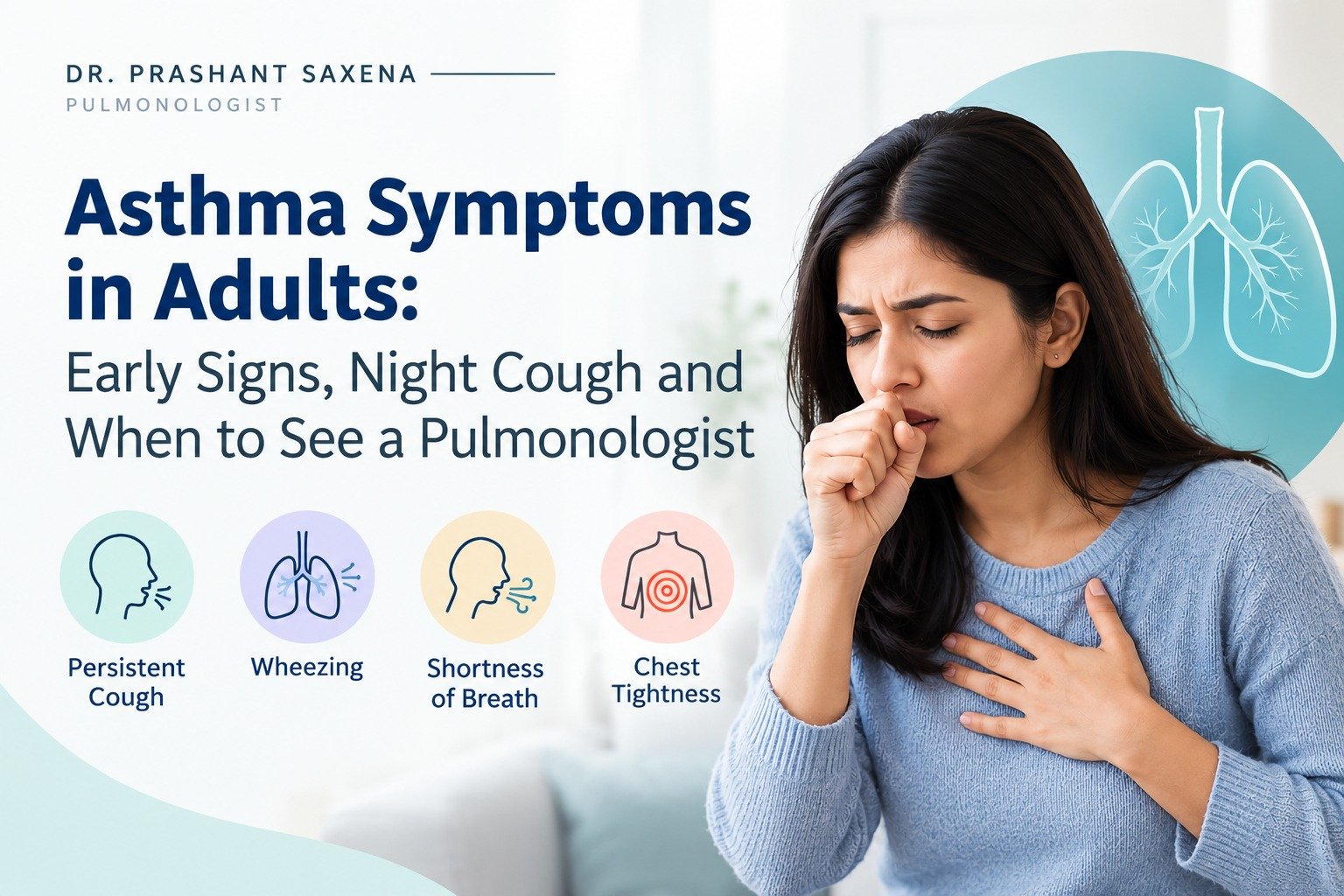
The Main Asthma Symptoms in Adults and What They Feel Like
Some people get all symptoms, some only ever notice one nagging thing and almost nobody feels them every day. It’s unpredictable by nature.
Cough
Does asthma cause coughing? It can, quite often. Some adults never get anything else: no wheeze, no breathlessness, just a cough that won’t quit. It’s usually dry, with maybe a little clear mucus. It starts up when you lie down at night and again around dawn. Cold air can start it. So can a hard laugh, strong incense or hurrying for the bus. Colds leave coughs behind, but those fade in a week or two. If yours is still here at week three, or comes back with every sniffle, it’s a different animal.
Wheezing
Think of a kettle starting up, except it’s coming from your chest. It’s the sound of air pushing through airways that have squeezed down. Husbands and wives often hear it first, usually at night. But wheezing isn’t proof of asthma and plenty of asthma has none, so don’t make up your mind from this alone.
Shortness of Breath
You can’t pull in a full breath, as if the air gets halfway and quits. Stairs bring it on, or a fast walk, or even talking too long on a call. What gives it away is how patchy it is. Tuesday’s walk to the chai stall is no trouble and the exact same walk on Wednesday has you stopping to catch your breath.
Chest Tightness
This may vary by a mile. Some say a belt buckled a notch too tight, others a palm pressed flat on the breastbone, others a bag of atta sitting on the chest. Cough and wheeze often come along with it. Separate warning and an important one: chest pain with sweating, or pain running into the arm or jaw, should never be assumed to be asthma. That could be your heart. Get urgent care.
| Symptom | What It Feels Like | Clue It’s Asthma |
|---|---|---|
| Cough | A dry, tickly cough, sometimes with a little clear mucus | Gets worse after dark or in cold air and lingers after colds |
| Wheezing | A squeaky whistle, mostly on the way out | Comes in spells, louder during flare-ups |
| Shortness of breath | Running out of air on stairs or while talking | Changes from day to day and eases with a reliever |
| Chest tightness | A band or weight across the chest | Turns up around triggers or at night |
Mild intermittent asthma symptoms deserve a special mention, since they’re the ones people shrug off. We’re talking symptoms on two days a week or fewer and night waking no more than twice a month. Easy to ignore, yes. Still asthma though and a bad flare doesn’t care that your usual pattern is mild.
Early Signs Adults Often Miss
Hardly anyone books an appointment saying “I think it’s asthma.” They talk about feeling flat or about all the chest infections they’ve had this year.
What do the early symptoms of asthma actually look like?
Often it starts with a cough that is still around weeks after the cold has gone. Stairs begin to leave you huffing and you blame the desk job. Some nights you wake at 2 am coughing for no obvious reason.
Sweeping the house, standing near a smoky tawa or stepping out on a cold morning makes your chest clamp. Then come the “chest infections” that never properly clear, whatever antibiotic you’re given, plus a throat you’re clearing all day with a bit of mucus.
Location is the clue people miss. Fine on a hill-station holiday but wheezy back at the office? Perfectly well until November every year? Then something around you is setting it off.
Before you see anyone, start a diary and keep it going for two weeks. Time of day, place, what you were up to, what helped. Nothing fancy. Scribbled notes like that give a doctor far more to work with than “I get breathless sometimes.”
Recognising an Asthma Emergency
Plenty of flare-ups ease off once you’ve taken your reliever the way your doctor showed you. The dangerous ones don’t. If you see any of the following, head for an emergency department or ring 112:
- You can’t speak a full sentence without stopping for air
- Breaths come fast and every one is an effort
- The skin between your ribs or in the notch of your throat sinks inward with each breath
- Lips or fingertips are turning bluish or grey
- The reliever isn’t helping much, or its effect wears off within three to four hours
- You’re leaning forward and can’t lie flat
- You’re worn out, muddled or oddly sleepy
- The wheeze has stopped but you’re still struggling
Until help arrives, stay sitting up and keep taking the reliever exactly as your action plan says. Waiting to see whether it blows over is a gamble you shouldn’t take.
What Causes Asthma?
Nobody has found one culprit. Asthma seems to build when inherited genes meet years of allergens, infections and dirty air and the airways end up inflamed and quick to overreact.
You May Be at Higher Risk If
- Close relatives with asthma, eczema or hay fever
- You have allergies of your own
- You spent childhood around cigarette smoke or thick pollution
- You had lots of chest infections when you were small
- You were a premature or small baby
- You carry extra body weight
- Your job involves dust, flour, paint fumes or chemicals
Common Asthma Triggers
A trigger is only the match. The fuel was already there, in airways that were sensitive to begin with.
- Household allergens: dust mites, mould, pet hair and cockroach droppings, plus seasonal pollen
- Anything smouldering, from beedis and incense sticks to mosquito coils and a tadka gone wrong
- Smog, exhaust fumes and fine particles
- A blast of cold, dry air, or stepping from a hot street into a chilled mall
- Viral infections, which cause more flare-ups than anything else
- Exercise, especially outdoors in winter
- Perfume, air fresheners, floor cleaners and fresh paint
- Acid reflux, mostly after dinner or at night
- Aspirin-type painkillers and beta blockers, in a minority of people (never stop a prescribed medicine without asking your doctor)
- Stress, crying or a proper belly laugh
Why Asthma Is Often Worse at Night and Early Morning
There’s a reason 3 am is prime time. Your airways run on a body clock too. In the small hours they tighten slightly, while cortisol and adrenaline, which usually keep things settled, run low. Lying flat doesn’t help. Mucus slides toward the throat and stomach acid has an easier climb. Then there’s the bedroom itself.
Dust mites in a mattress you’ve had for years, a cold AC blowing at your face, a filter nobody has cleaned since last summer, winter smog leaking in around the windows, the dog on the duvet, damp patches on the wall.
Waking with asthma symptoms more than twice a month is a sign the condition isn’t under control. GINA sets the bar lower, as you’ll see further down and counts even one night.
For tonight: a hot wash for the bedding, covers on pillows and mattress, the AC filter cleaned and the airflow aimed away from you, windows shut if the AQI is bad, an extra pillow to prop you up. And the reliever within arm’s reach.
Steam, kadha and haldi doodh are comforting, no argument there. They just don’t touch the swelling inside the airways, and a bowl of steam can scald you or aggravate the cough. Don’t let a home remedy stand in for the inhaler.
Asthma Without Wheezing
Ask anyone what asthma sounds like and they’ll say wheezing. Which is why adults without that sound can go years with nobody mentioning asthma at all.
When the Only Symptom Is a Dry Cough (Cough-Variant Asthma)
Just a dry cough. No wheeze, nothing else, going on for eight weeks or longer and worse at night, after exercise or in cold air. It gets labelled post-nasal drip, reflux or “another infection” constantly. Here’s the catch. Chest sounds can be perfectly clear and the usual breathing test can come back normal. That’s when doctors go for more specialised tests, or try asthma treatment for a few weeks under supervision and watch whether the cough fades.
Asthma Symptoms Without a Cough
Plenty of people with asthma never cough at all. Some only notice breathlessness when they push themselves, or a chest that feels tight, or a wheeze that begins minutes after the gym session is over. Climbed stairs without thinking last year and now you’re puffing by the second floor? Say it out loud to a doctor. Age is the lazy explanation.
The Quiet Chest: When Wheeze Disappears in a Severe Attack
Families get caught out by this one. In a really severe attack the airways narrow so much that barely any air gets through and with so little air moving there’s nothing to whistle. Silence isn’t an improvement. The Global Initiative for Asthma (GINA) lists a silent chest as one of the danger signs in a life-threatening attack. Watching someone struggle for air in silence? Don’t wait. Ring for emergency help straight away.
Mucus, Colds and Fever: Asthma Alongside an Infection
Asthma on its own tends to bring clear or whitish mucus. Yellow or green usually means a viral infection has joined in and colds are the single biggest trigger of flare-ups. Fever is where the story splits. Asthma doesn’t produce a temperature. So a cough or breathlessness plus fever points towards flu, pneumonia or TB, and you need to be seen. Doubling the inhaler isn’t the answer.
Is It Asthma or Something Else?
Plenty of other conditions pass themselves off as asthma.
| Condition | How It Tends to Differ | Why a Test Matters |
|---|---|---|
| COPD | Mostly over 40, with years of smoking or smoke exposure; gets steadily worse and brings a daily cough with phlegm | Spirometry shows airflow that stays blocked even after an inhaler |
| TB | A cough of two weeks or more along with fever, night sweats and weight loss | Needs a sputum test and chest X-ray and asthma medicines won’t touch it |
| Heart-related breathlessness | Worse lying flat, jolting awake gasping, puffy ankles | Needs an ECG and echo; no inhaler will fix it |
| Anxiety | Quick shallow breaths, pounding heart, tingling hands, rarely any wheeze | Normal lung tests help, though both can exist together |
| Reflux or post-nasal drip | A sour taste, heartburn, endless throat clearing, a cough after meals or when you lie down | Either can imitate asthma or trigger it, so both are worth ruling in or out |
Telling these apart takes a doctor and a breathing test, nothing else. Long cough, fever and weight loss? Then read our guide to tuberculosis symptoms and diagnosis for the warning signs.
Adult-Onset Asthma: Why It Starts Later and What Sets It Off in Delhi NCR
Why Asthma Can Start After 30
A lot of adults still believe asthma is something you get as a kid or never get at all. Not so. It can begin at 35 or at 50 and women seem to be hit more often than men.
So what changes?
A new allergy might appear. A nasty infection can leave the airways jumpy for months. Dust or fumes at work, year after year, take their toll. Pregnancy and menopause bring big hormonal swings, which seem to play a part.
Extra kilos don’t help either and smoking inflames the airways directly. Long-standing acid reflux irritates them from below.
Triggers in Delhi NCR
Living in Delhi, Gurgaon or Noida? Roughly in this order, these are the ones to watch:
- Smog season and any high-AQI day. Once the CPCB index crosses 200, the “poor” band, symptoms tend to jump
- Diwali firecracker smoke, which dumps fine particles into air that’s already bad
- Construction dust, from metro sites and torn-up roads to the tower going up next door
- Winter viruses, meaning the usual rounds of cold and flu
- Monsoon damp and mould behind walls and in wardrobes
- Cold, dry air on early morning walks
- Cooking and incense smoke in poorly ventilated homes
- Strong perfumes and cleaning products
Bad air day? Check the AQI before leaving, put on a snug N95 and keep your reliever in your bag.
How Controlled Is Your Asthma? The GINA Four-Question Check
Think back over the last four weeks:
- Did daytime symptoms show up on more than two days a week?
- Did asthma wake you at night, even once?
- Did you reach for your reliever more than twice a week?
- Did asthma hold back anything you wanted to do?
Answer yes to any of them and it’s time to talk to a doctor. More yeses mean worse control.
When to See a Pulmonologist and What to Expect
Make the appointment if a cough or breathlessness is still going after three weeks, keeps coming back or breaks your sleep. Same if you’re using a reliever more than twice a week, or you’ve started dodging stairs and exercise because of your breathing.
Nothing scary happens at a first visit. You’ll be asked a lot of questions: what the symptoms are like, what sets them off, whether asthma or allergies run in the family, what you do for work, what your home is like, whether you smoke. Then the doctor listens to your chest and checks your nose and throat. Finally there’s spirometry, where you blow hard into a tube. It’s often done twice, once before and once after an inhaler, to see how your airways react. Bring your diary and any old prescriptions.
Tired of guessing? Book a consultation with Dr. Prashant Saxena in Gurgaon.
A Two-Minute Self-Check
Answer yes or no:
- Has a cough lasted beyond three weeks or kept returning?
- Does your chest whistle or squeak when you breathe out?
- Do you ever wake in the night coughing or short of breath?
- Do dust, smoke, cold air or exercise make your chest tighten?
- Do asthma, eczema or allergies run in your family, or in you?
Two or more yeses? Book a consultation. This quiz isn’t a diagnosis and can’t be one. Asthma gets confirmed by a doctor who has examined you and tested your breathing.
FAQs
What Does Asthma Feel Like?
Most people say it’s like sucking air through a coffee stirrer while a strap tightens across the chest. Add a whistle and a cough that won’t settle. Then, an hour or a day later, it lifts and you feel absolutely normal.
Why Did I Get Asthma at 40?
Usually several things stack up: a fresh allergy, a bad chest infection, a dusty workplace, hormonal changes, extra kilos, reflux, ten years of Delhi air. Any of those can tip sensitive airways over. You didn’t cause it and it can be treated.
What Is the Best Treatment of Asthma?
Treatment works best when it is matched to the patient. Most adults need a daily preventer inhaler to calm airway inflammation and a reliever inhaler for sudden symptoms. Trigger control matters just as much. Severe or stubborn asthma may need biologic therapy, which a pulmonologist decides after proper testing.
What Are the Most Common Asthma Symptoms in Adults?
Cough, wheeze, breathlessness and chest tightness lead the list. They tend to turn up in spells and get worse after dark or around triggers like dust and smoke.
Can You Have Asthma Without Wheezing?
Yes. Cough-variant asthma is exactly that, a dry cough and nothing else. Other people only feel it as breathlessness or tightness during exercise. And in a severe attack the wheeze can go quiet. That isn’t improvement, it’s a warning.
Does Asthma Cause Coughing?
It does. Usually a dry one, sometimes with a smear of clear mucus, that flares at night, after a run or in cold air. Three weeks or more, or a habit of returning, means get it checked.
Why Is Asthma Worse at Night?
Overnight the airways narrow a touch, the hormones that keep them calm run low and lying flat gives mucus and acid reflux an easy route up. Dust mites, cold AC air and smog pile on.
Does Delhi and Gurgaon’s Air Pollution Make Asthma Worse?
Yes. Tiny particles and gases from traffic and smoke get deep into the lungs and inflame the airways, which is why flare-ups bunch up on high-AQI days. Look at the air quality before you step out, put on an N95 when it’s poor and don’t leave home without your inhaler.
Which Doctor Should I See for Asthma Symptoms in Gurgaon?
A pulmonologist. In Gurgaon, you can consult Dr. Prashant Saxena, a pulmonologist with 14 years of experience who has helped many people manage their respiratory conditions and improve their quality of life.