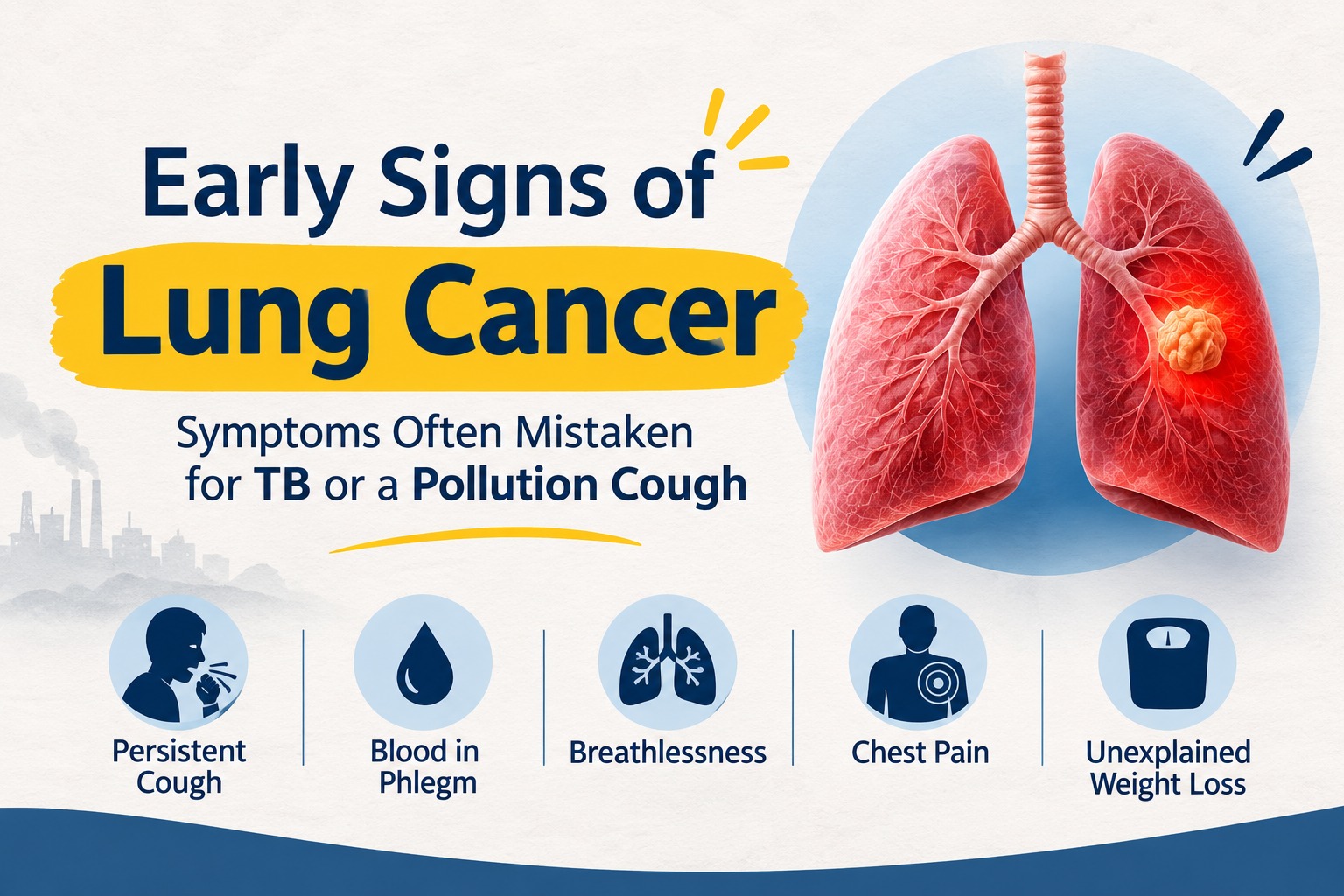
Lung cancer’s early signs are easy to wave away: a cough that’s still hanging about after three weeks (or sounds different from before), a thread of blood in your phlegm, chest infections on repeat, puffing on stairs that never used to bother you, a niggling ache in the chest or shoulder, a voice gone hoarse, kilos dropping off for no reason. Often there are no early signs at all. In India, whatever does show up usually gets pinned on TB or the smog first. Anything that’s lasted three weeks deserves a pulmonologist’s opinion.
Why It’s So Easy to Miss
Strange but true: the lungs have hardly any pain-sensing nerves. So a tumour can sit in there quietly for months and you’d be none the wiser.
Location changes the story too. A growth near one of the big airways gets noticed sooner, because it irritates the airway and you cough, sometimes with a bit of blood. One out at the edges of the lung? It can grow quietly until it’s large or has already spread.
So it isn’t really surprising that most people here are diagnosed late. Take one Indian hospital’s numbers: of 416 lung cancer patients, 72.6% had already reached stage III or worse by the time anyone gave them a diagnosis (Indian Journal of Respiratory Care, 2022). A 2023 Lung India review says much the same, and puts part of the blame on cancer being taken for TB (Lung India, 2023).
Catching it earlier mostly comes down to one thing. Not ignoring the small stuff.
Early Signs of Lung Cancer (Lung Tumour Symptoms)
Before you panic: almost everything below is far more likely to be an infection, an allergy, asthma or TB. Cancer is the less likely answer. What you’re really watching for is a symptom that overstays, gets worse, or just feels off compared to your normal.
A Cough That Won’t Quit (or Sounds Different)
This is the big one. A new cough that’s still around after three weeks, with no cold or fever to explain it, deserves a proper look.
If you smoke, you’ve likely had a morning cough for years and stopped hearing it. Start listening again. Is it deeper now? More frequent? Does it hurt? Does it just sound different? That change is the thing.
Blood When You Cough
A streak of red, or phlegm that looks a bit rusty. Most of the time it’s an infection or bronchitis. But chest doctors take it seriously every single time, so don’t sit around waiting for a repeat.
More Phlegm, or a Different Colour
Bringing up more phlegm than you used to, or phlegm whose colour shifts and never shifts back. A tumour rubbing against an airway, or half-blocking it, can do that. On its own it’s usually just an infection. Paired with a cough that won’t quit, get it checked.
Chest Infections on Repeat
Pneumonia around Holi. Bronchitis again by May. Yet another strip of antibiotics in July. When it’s the same patch of lung every time, something could be blocking that airway, so mucus collects behind it and goes bad again and again.
Antibiotics will clear each infection. They won’t touch whatever is causing them.
Puffing on the Stairs
Third-floor flat, no lift, never an issue. Lately you pause on the landing to catch your breath. A tumour can squeeze an airway narrower or let fluid pool around the lung, and the change is slow enough that most people blame their age, their weight or the AQI.
That Ache in Your Chest, Shoulder or Back
Could be a dull ache that never fully goes, or something sharper that catches you when you cough, laugh or take a big breath. A tumour near the top of the lung can lean on nerves and turn up as shoulder or upper-back pain, the kind we all write off as a bad pillow or too many hours hunched over a laptop.
A Voice That Stays Hoarse
One of the nerves that runs your voice box takes a detour through the chest, close to the lung. Press on it and your voice turns rough. Three weeks of croakiness with no cold behind it is worth getting checked.
Weight Loss and Tiredness You Can’t Explain
Kurtas getting loose though you haven’t changed what you eat. No appetite. Waking up drained after eight hours in bed. Vague stuff, honestly, and that’s precisely why it gets missed.
Normal or Worth Checking?
| Symptom | Probably Nothing If | Get It Seen If |
|---|---|---|
| Cough | It came with a cold and was gone inside three weeks | It’s past three weeks, or your old cough has changed |
| Blood in phlegm | Never assume it’s nothing | Even one streak |
| Phlegm | Clear or white, and it cleared with the cold | More of it, or a new colour that sticks |
| Chest infections | One after a viral fever, then fully better | Two or more in a few months, or the same spot again |
| Breathlessness | After a hard workout or a bad AQI day, then fine | Worse week after week |
| Chest or shoulder pain | After lifting something heavy, gone in days | Constant, worse with coughing or breathing, or wakes you up |
| Hoarse voice | With a cold, back to normal in a week or two | Still rough after three weeks |
| Weight loss | You’ve been dieting or working out | Dropping without trying |
Less Obvious Signs (the Ones People Ignore)
A few lung tumours give themselves away somewhere you wouldn’t expect. Less common, yes, but worth a mention to your doctor if you notice one.
Finger clubbing. Look at your fingertips. If they’ve turned wider and rounder, with the nails curving down over them, that’s clubbing. Sometimes it comes with sore, swollen wrists, ankles or knees, a condition called hypertrophic pulmonary osteoarthropathy (HPOA).
One droopy eyelid. A tumour right at the top of the lung can press on nerves heading to the face. The eyelid droops, the pupil on that side looks smaller, and that side may sweat less. Doctors call it Horner syndrome.
A puffy face or neck. If your face, neck or arms swell up, a tumour may be pressing on the big vein that drains the upper body (superior vena cava syndrome). Don’t sit on this one. Go to a hospital.
“Water in the lungs.” Cancer can make fluid build up between the lung and the chest wall, which doctors call a pleural effusion. You feel it as breathlessness that gets a little worse every week.
Why Lung Cancer Is Often Mistaken for TB in India
Put an early lung cancer patient next to someone with TB and you’d struggle to tell them apart. Long cough. Weight loss. Tiredness. Chest pain, sometimes blood. Both can leave a shadow on the X-ray. And because TB is so common in India, it’s the first thing families suspect, and often the first thing that gets treated.
That habit has a cost. A South Indian hospital went back through the earlier consultations of 96 lung cancer patients. Only 45% of the doctors they had seen suspected cancer. About 18% diagnosed TB instead, and 88.6% of those doctors started anti-TB treatment. Pulmonologists were the most likely to get it right.
At a rural medical college in central India, nearly one in four lung cancer patients (23.4%) had first been put on TB medicines. Their wait from first symptom to an actual cancer diagnosis? 5.7 months, on average.
A few clues tip things towards cancer, like being older, years of smoking, a hoarse voice, a swollen face or neck, or food sticking when you swallow. But the clearest warning sign is a simple one. TB treatment that isn’t working. Several weeks on anti-TB medicines and you’re no better? Or you were started on them on the strength of an X-ray alone, with no test confirming TB? Ask to see a pulmonologist. A CT scan, and sometimes a bronchoscopy, will usually settle it.
Our guide to tuberculosis symptoms and diagnosis explains how TB itself is confirmed.
Pollution Cough or Something More?
Come November, it feels like all of Delhi NCR is coughing. Diwali smoke, stubble burning, traffic, construction dust. A scratchy throat becomes part of the season.
A pollution cough tends to move with the AQI. It’s worse on bad days, eases when the air clears or when you leave town for a week, and doesn’t bring blood or weight loss with it. The cough to worry about is the one still hanging around after the smog lifts, getting worse, or turning up with any of the signs above. If smog season leaves you wheezing and tight in the chest, it may be asthma, so have a look at our guide on asthma symptoms in adults.
Lung Cancer in Non-Smokers
Plenty of people still think of lung cancer as a smoker’s disease. In India, that’s simply not true. When Sir Ganga Ram Hospital in Delhi studied 150 of its lung cancer patients, half were non-smokers, 21% were under 50 and 20.6% were women (The News Minute). A study in the Lancet’s eClinicalMedicine journal found lung cancer turns up in India roughly 10 years earlier than in Western countries (Business Standard). And an Indian expert panel in 2024 listed air pollution, smoke from biomass cooking fuel and bidi smoking among the local risk factors.
Are the Signs Different in Women?
Not really. The signs are the same. The difference is who notices them.
Ask most non-smoking women with a lingering cough what it could be, and cancer won’t make the list. Their families won’t think of it either. It doesn’t help that adenocarcinoma, the type non-smokers tend to get, usually grows in the outer lung, where it can stay silent for ages. Throw in years spent cooking over a wood or cow-dung chulha and the odds go up again.
When Should You See a Pulmonologist?
Any of these ringing a bell? Book an appointment.
- a cough that’s lasted more than three weeks, or an old cough that has changed
- any blood in your phlegm, even once
- two or more chest infections or bouts of pneumonia within a few months
- TB treatment that isn’t helping
- a new cough if you’re over 50 and smoke, or used to
- weight loss you can’t account for
Don’t wait for an appointment if you’re coughing up more than a little blood, suddenly struggling to breathe, or your face, neck or arms are swelling. Go to emergency.
Why not just your family doctor? Nothing against them, but chest specialists hear coughs from morning to evening and get very good at sorting the ones that need a CT scan from the ones that need cough syrup and a bit of patience. The South Indian study backs this up: pulmonologists were the most likely to catch the cancer.
Live in Gurgaon or nearby in Delhi NCR? You can book a consultation with Dr. Prashant Saxena at Artemis Hospitals, Gurugram.
What Tests Confirm Lung Cancer?
If your doctor’s suspicious, here’s roughly the order things go in.
Chest X-ray first. Cheap, fast, and not great at spotting small tumours or ones tucked behind the heart or ribs. A normal X-ray isn’t always the end of the story.
Then a CT scan of the chest. Far more detail. Nodules too small for an X-ray show up here.
PET-CT, when the CT finds something. This shows how active the spot is and whether anything has spread.
A biopsy to be sure. Nobody can say “cancer” for certain until a pathologist has looked at the tissue. Usually a pulmonologist collects it with a bronchoscope, a thin bendy tube slipped through your nose or mouth down into the airways. EBUS (endobronchial ultrasound) adds a small ultrasound probe to the tip, which lets the doctor steer a needle into lymph nodes in the chest. One procedure, two answers: is it cancer, and how far has it gone? Tumours near the edge of the lung are sometimes easier to reach with a CT-guided needle through the chest wall instead.
Lab tests on the sample. The lab works out exactly which type of lung cancer it is, and often checks for gene changes that decide which medicines will work.
From there, treatment is planned by an oncologist along with the rest of the cancer team. You can see the procedures Dr. Saxena performs on our services page.
Conclusion
Early lung cancer doesn’t make much noise. When it finally does, it sounds like TB, or the smog, or a smoker’s cough. So forget how alarming a symptom feels. Ask how long it’s been around and whether it’s changing. Three weeks is long enough. When you’re ready, Dr. Prashant Saxena sees patients at Artemis Hospitals, Gurugram.
FAQs
What’s Usually the First Sign of Lung Cancer?
For most people, a cough. One that won’t settle, or one that starts sounding different. Then again, lots of early lung cancers have no symptoms and get spotted by chance on an X-ray done for something unrelated.
Can You Have Lung Cancer Without Any Symptoms?
Absolutely, especially if it’s growing in the outer lung. That’s why a stubborn cough or unexplained weight loss deserves attention.
When Should I Worry About a Cough?
Three weeks is the usual line. Blood, a cough that keeps worsening, or one that brings breathlessness, chest pain or weight loss along with it? Don’t wait the full three weeks.
How Is a Lung Cancer Cough Different From a Pollution or Smoker’s Cough?
Pollution coughs settle once the air does. A smoker’s cough sounds the same year after year. A cancer cough sticks around, worsens or changes its character, and sometimes brings up blood.
Is Coughing Up Blood Always a Sign of Lung Cancer?
No. Infections, bronchitis and TB are much more common culprits. Still, get it seen, even if it happened just the once.
Does Lung Cancer Cause Phlegm or Mucus?
Sometimes, yes, if the tumour irritates or blocks an airway. There’s no “cancer colour”, but phlegm with blood in it or a rusty tinge shouldn’t be ignored.
How Can I Tell if My Cough Is TB or Lung Cancer?
Honestly? Not by symptoms. A sputum test, a CT scan and sometimes a bronchoscopy are what tell them apart.
My TB Treatment Isn’t Working. Could It Be Lung Cancer?
Possibly. Worth ruling out, at least. If several weeks of anti-TB medicines haven’t helped, have a pulmonologist go through your reports.
Can Non-Smokers Get Lung Cancer From Air Pollution?
Yes. Air pollution is a recognised cause, and in one Delhi hospital study, half the lung cancer patients were non-smokers.
Are the Early Signs of Lung Cancer Different in Women?
The signs are the same. Women who don’t smoke are just more likely to brush them off, and the type common in non-smokers can stay quiet for a long time.
Can a Chest X-ray Miss Lung Cancer?
It can. Small tumours, and ones hiding behind the heart or ribs, slip past it easily. Still unwell after a normal X-ray? Ask about a CT.
Who Should Get a Low-Dose CT Scan for Lung Cancer in India?
India doesn’t run a formal screening programme yet. If you’ve smoked for years or are at high risk for other reasons, ask your pulmonologist whether a low-dose CT makes sense.
Is Lung Cancer Treatable if It’s Caught Early?
Yes. Caught early, lung cancer has far more options, surgery often among them, and much better outcomes.
Which Doctor Should I See First for a Cough That Won’t Go Away?
A pulmonologist, or chest specialist. They’ll work out whether it’s asthma, TB, an infection or something more serious, and order the right tests.